
A product quality issue can quickly become a major business problem. When a defective or contaminated batch reaches the market, manufacturers need to know three things: which products are affected, where they have gone, and which materials were used to make them.
If this information is scattered across spreadsheets, paper records, and disconnected systems, identifying affected products becomes difficult and time-consuming.
Effective product traceability helps businesses answer these questions quickly, limit disruption, and protect customer trust.
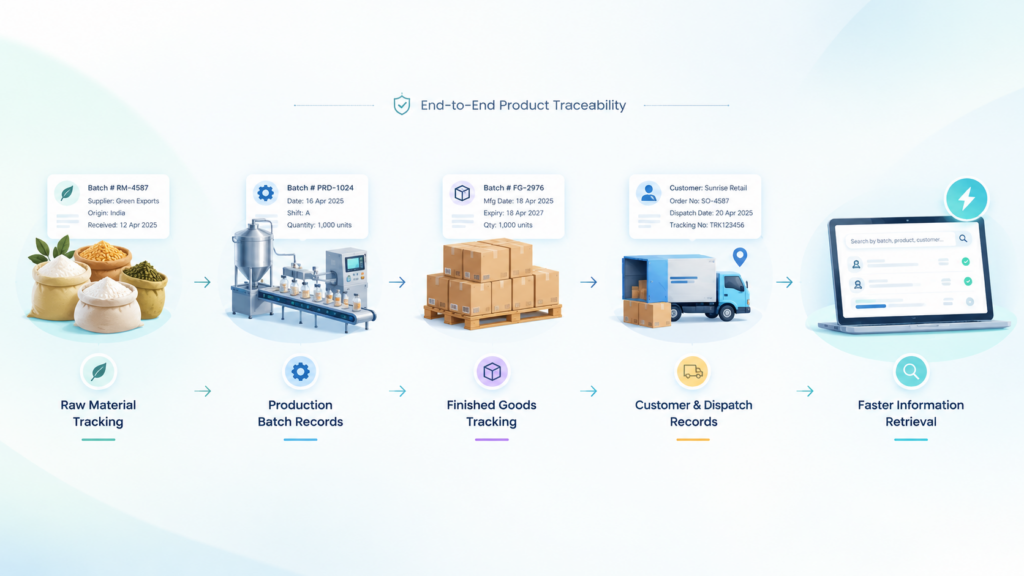
Product traceability allows manufacturers to track a product’s journey from raw materials and production to finished goods and final dispatch.
Without reliable traceability, businesses may struggle to:
These challenges are particularly important in industries such as pharmaceuticals, food, and chemicals, where batch identification and quality records play a critical role.
Many manufacturers record inventory, production, and dispatch details but fail to connect them into one clear history.
For example, a raw material may have a supplier lot number, while the finished product has a separate batch number. If these records are not linked, tracing the material through production can require manual investigation.
Common causes include:
When a quality issue arises, these gaps delay investigations and make it harder to determine the scope of the problem.
An ERP system can connect information across purchasing, inventory, production, quality, and dispatch. This gives teams a clearer view of a product’s history.
These capabilities support faster, more targeted responses. However, their effectiveness depends on accurate data entry, appropriate system configuration, and clearly defined processes.
Traceability should be tested before a product quality issue occurs. Manufacturers can start by asking:
Regular traceability checks help reveal missing information and process gaps before they become urgent problems.
Businesses should also establish clear procedures for stock quarantine, quality investigations, customer communication, and recall decisions. Industry-specific regulatory requirements must be reviewed separately to ensure the processes meet applicable obligations.
Product traceability should not depend on employees manually piecing together information during a crisis. It should be built into everyday business operations.
An ERP system that connects batch records, inventory movements, production data, and dispatch information can help manufacturers improve visibility and respond more confidently when quality issues arise.
Vision ERP by Proteus Technologies supports business processes across manufacturing and inventory management. Businesses evaluating their traceability needs should assess how their ERP connects material batches, production records, quality information, and dispatch data.
A product recall may not always be avoidable. But with reliable traceability, businesses can identify affected products faster, reduce unnecessary disruption, and make better-informed decisions when it matters most.