
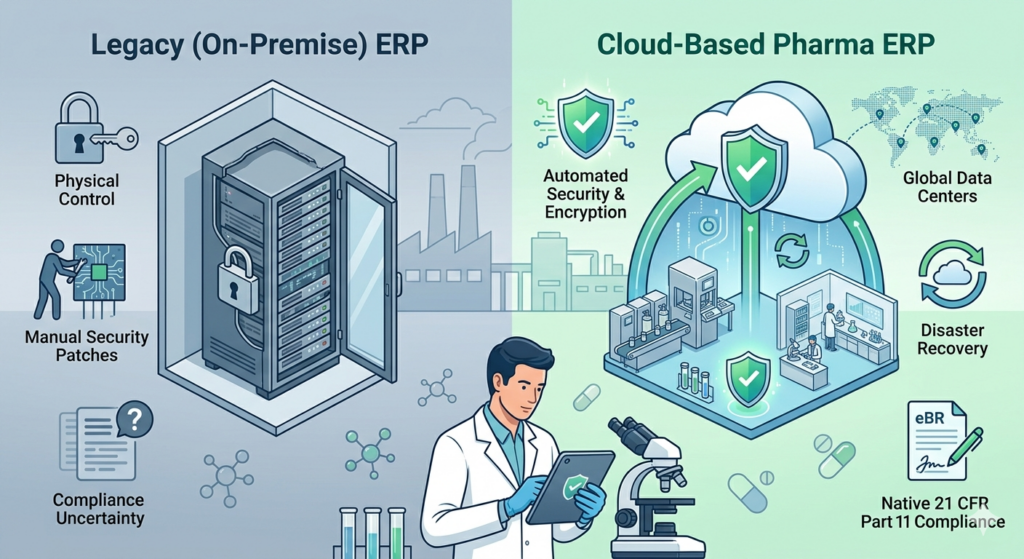
In the pharmaceutical industry, your data is your most valuable asset. Between proprietary formulations, clinical trial results, and sensitive patient data, the “vault” you choose to store this information in matters.
For years, the industry standard was the On-Premise ERP: the comforting sight of a physical server humming in a locked room. However, as cyber threats evolve and remote work becomes the norm, a critical question has emerged: Is “closer” actually “safer”?
Here is a deep dive into the security reality of Legacy vs. Cloud ERPs for the modern pharmaceutical manufacturer.
Many pharma executives believe that if they can physically touch the server, their data is safe. This is often an illusion.
Cloud ERPs, particularly those designed for life sciences like Vision ERP, utilize infrastructure (such as AWS or Azure) that spends billions on security, far more than any individual pharma company could.
In the cloud, security updates happen automatically. You don’t have to wait for a technician to “fix” a vulnerability; the system is constantly evolving to outpace hackers. This is critical for maintaining 21 CFR Part 11 status, where data integrity must be constant.
Cloud ERPs ensure that even if a data packet is intercepted, it is unreadable. Your sensitive formulations are encrypted while sitting in the database (“at rest”) and while being sent to a user’s laptop (“in transit”).
With a Cloud ERP, your data is mirrored across multiple geographic locations. If one data center goes down, another takes over instantly. For a pharma company, this means zero downtime and no risk of losing critical batch records.
The biggest concern with Cloud ERP in pharma is Validation. “If the software updates automatically, doesn’t that break my validated state?”
Modern Cloud ERPs solve this through “Managed Validation.” Instead of forced, disruptive updates, pharma-specific cloud providers offer “Validation Sandboxes.” You can test the new update in a safe environment before it goes live, ensuring you stay compliant with GMP standards while still benefiting from the latest security.
While Legacy systems offer the feeling of control, Cloud ERPs offer the reality of protection. For pharmaceutical SMEs looking to scale without hiring a 20-person cybersecurity team, the Cloud is the clear winner. It provides the high-level encryption, multi-factor authentication (MFA), and disaster recovery required to satisfy both the FDA and your IT department.
Stop worrying about server maintenance and start focusing on medicine. Vision ERP offers a secure, cloud-based environment specifically tailored for pharmaceutical compliance and data integrity.