
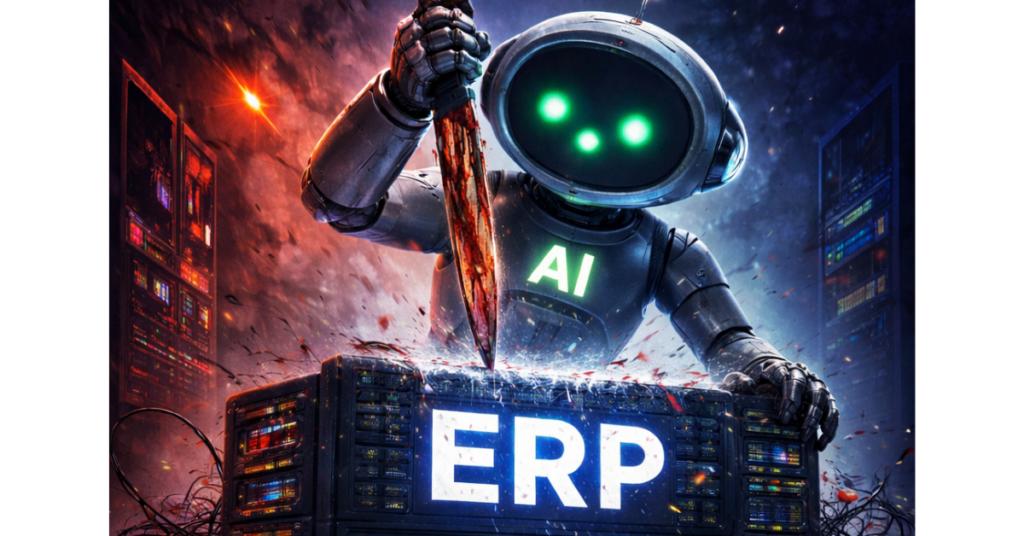
Having built an ERP product from the ground up, I’ve watched the industry grapple with many trends. But the question looming largest today is deceptively simple: “Will AI kill ERP?”
It’s the right question, but for the wrong reasons. The need for what an ERP does to plan, record, and manage the resources of a business: is eternal. A business cannot run without its system of record.
However, the way we interact with that system, and the intelligence it provides, is about to change so dramatically that the ERP of 2035 will be unrecognizable compared to the ERP of today. So, will AI kill it? The answer is more complex than a simple yes or no. AI won’t kill ERP, but it will force a metamorphosis. It will rewrite the genetic code of what an ERP is. If your ERP refuses to evolve, it won’t be murdered by AI; it will simply die of obsolescence.
There is a popular theory that AI will allow anyone to generate an application. The idea is that a company could simply prompt an AI to “build me an ERP” and be done with it.
My response, based on years of experience, is: Good luck with that.
Yes, developers will absolutely use AI-assisted coding tools to build ERP modules faster than ever before. But what they will create is not a product; it will be a bespoke, fragile solution unique to the company providing the prompts.
The success of this endeavor hinges entirely on the “business knowledge” of the prompter. An ERP isn’t just a collection of tables and forms. It is a digital manifestation of complex business logic: inventory valuation methods (FIFO, LIFO, Weighted Average), multi-currency accounting rules, intricate tax structures, and supply chain dynamics.
A prompter might be able to generate a beautiful “Create Invoice” screen, but will they know to prompt for the specific general ledger impact of a discount on early payment in a specific tax jurisdiction? Unlikely. AI can generate code, but it cannot replace the decades of collective business process knowledge baked into a mature ERP product. Bespoke code built on prompts is a recipe for an un-auditable, unscalable mess.
So, if AI can’t just build a new ERP from scratch, what will it do? It will fundamentally alter the DNA of existing ERP products. This isn’t about adding a “ChatGPT” button to your dashboard. It’s about a complete system redesign.
The first generation of ERP was about recording history. It was a passive ledger. The next generation will be about anticipating and acting on the future.
The new AI genetics will create an ERP that is superior to its predecessor in every way. It will be proactive, not reactive.
The most profound change will be the disappearance of the “driver.” For decades, the ERP has been a passive system, a hungry beast that needs to be fed data by human hands.
I foresee a future where the traditional data entry screens vanish. The ERP will become an autonomous nervous system for the business.
Imagine this:
All of this happens without a single human logging in to “enter data.” The ERP gathers its data autonomously from emails, partner portals, real-time bank statement feeds, and statutory body APIs. It creates the necessary transactions in the background, leaving humans to handle only the exceptions, the complex negotiations, the strategic decisions, the edge cases.
When the burden of data entry is lifted, what remains? The true purpose of an ERP: information.
AI won’t just automate tasks; it will provide superhuman intelligence from the data it now collects autonomously.
Strategic Recommendations: The system could analyze profitability not just per product, but per customer interaction style, advising sales teams on the most lucrative deal structures.
The future is not a battle between AI and ERP. It is a fusion. AI will be the heart and brain of the new ERP.
The screens will disappear, but the system of record will become more powerful than ever. The data entry clerk will evolve into a business process supervisor.
So, will AI kill your ERP? Yes, it will, if you choose to ignore it.
If you treat AI as just another feature, a bolt-on to your legacy system, your ERP will indeed die its death, slowly suffocated by its own inefficiency compared to the new, autonomous, intelligent platforms.
But if you embrace metamorphosis, if you allow AI to rewrite the genetic code of your product, you won’t just survive. You will build the operating system for the businesses of tomorrow. The death of the “old” ERP is not a tragedy; it’s the necessary sacrifice for the birth of something far greater.