
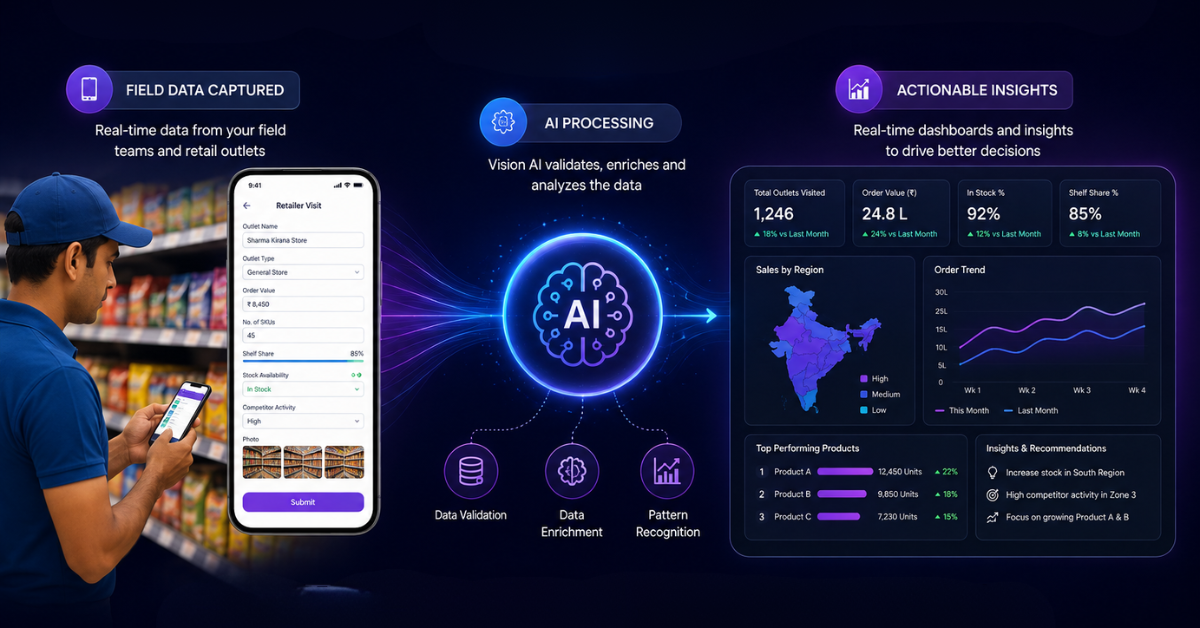
If you manage sales operations or trade marketing for a Fast-Moving Consumer Goods (FMCG) brand, you already know the hardest part of your job isn’t tracking primary sales (what you sell to your direct distributors).
The real nightmare lies in tracking secondary sales (what distributors sell to retailers) and tertiary/retail sales (what actually moves off retail shelves into consumer hands).
Without accurate secondary and retail sales data, you are essentially driving blind. You can’t calculate accurate distributor commissions, you can’t predict regional stockouts, and you risk over-producing goods that sit gathering dust in rural godowns.
Yet, gathering this data remains one of the most manual, error-prone processes in the FMCG industry. Here is why legacy data collection fails and how modern Vision AI is fixing it.
In a modern FMCG distribution network, primary data is clean because it originates in your own ERP system. However, as product moves further down the distribution chain, data structure completely falls apart:
Your top-tier urban distributors might use standard accounting software, but mid-tier distributors use local, proprietary POS systems. Every week, they email secondary sales statements in entirely different layouts, column structures, and file types.
In rural markets, sub-stockists and small village retailers often don’t use software at all. Field sales reps or stockist executives capture daily sales by taking photos of handwritten logbooks, paper physical stock sheets, or hand-drawn credit vouchers, often sending them over WhatsApp or physical mail.
To make sense of this chaos, FMCG companies hire internal data-entry teams or third-party agencies to manually transcribe hundreds of mismatched files and handwritten notes into a master spreadsheet.
By the time the data is cleaned, validated, and normalized, it is already too old to make real-time demand forecasting possible.
For years, FMCG brands tried basic Optical Character Recognition (OCR) tools or rigid software integrations to solve this. However, traditional tools break if a column header moves or if handwriting isn’t perfectly printed.
Vision AI approaches the problem differently. Instead of looking for rigid pixel templates, Vision AI uses contextual visual understanding to read, interpret, and structure documents based on your underlying business logic.
Automating secondary and retail data capture transforms trade operations from a reactive paper chase into a proactive growth engine:
When you know what sold at the retail level yesterday rather than two weeks ago your manufacturing plants can adjust production runs dynamically, preventing regional stockouts and minimizing inventory expiration risk.
FMCG brands spend millions on distributor incentives, discounts, and trade schemes. By capturing verified secondary sales records automatically, brands can audit distributor claims instantly, eliminating fraudulent or exaggerated claim payouts.
You no longer have to exclude rural sub-stockists from your digital reporting network just because they lack expensive POS software. Field reps can simply snap a photo of a physical bill book, bringing deep-tier retail sales into your central visibility loop.
Unlocking full visibility over your distribution pipeline requires a platform built to handle real-world supply chain chaos.
At Proteus Technologies, our Vision ERP and smart automation suite are engineered specifically for FMCG and distribution-heavy enterprises. With integrated Vision AI capabilities, your system can automatically read, map, and process secondary sales statements, handwritten field registers, and unstructured distributor reports.
Stop letting fragmented sales data delay your decision-making. Shift from slow manual entries to real-time, automated intelligence.